Introduction
The Directive is at the center of the operation of all alternative investment funds across Europe and establishes expectations of control, disclosure, and management. Its intent compels firms to make governance more of a structural requirement and not an afterthought. Most AIFMs today are streamlining their processes to achieve greater standards, which has enhanced confidence in cross-border activities. This base promotes more disciplined management of alternative investment funds and market behavior that is resistant to the pressure exerted by changing financial circumstances.
Strengthening Oversight Through Core AIFM Principles
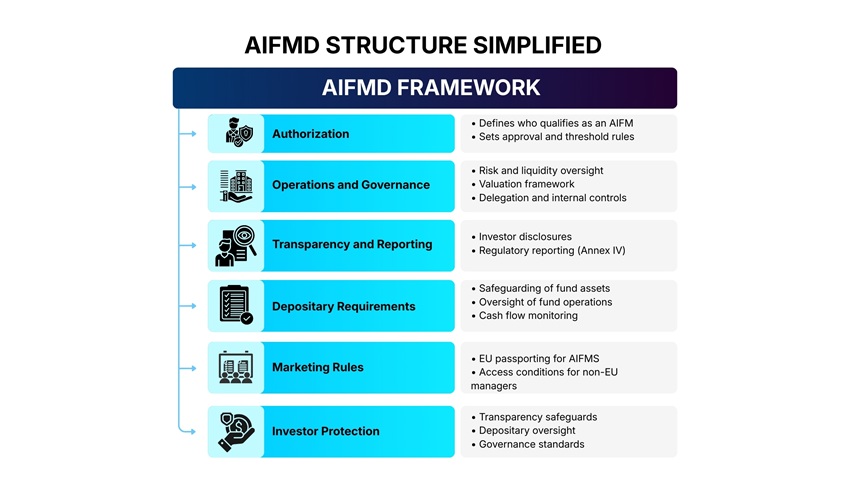
The Directive is based on several pragmatic principles, which outline what an AIFM is supposed to provide to the investors, supervisors, and markets. The supervisory attention focuses on the authorization standards, minimum capital requirements, and systems that enable prudent decision-making.
- Authorization and governance requirements: Before an AIFM can be granted permission to manage any alternative investment fund, it must demonstrate effective internal controls and well-defined responsibilities, particularly in portfolio and risk functions. The delegation of some of the important tasks is allowed on strict conditions, with the supervision being under the authority of the authorized manager.
- Principles of risk and liquidity management require managers to match leverage and redemption terms as well as portfolio liquidity with documented procedures and stress testing, which can be examined by regulators during inspection.
- The capital, risk control, and liquidity management rules require that each AIFM have adequate resources and documented processes, such as leverage limits, redemption controls, and stress testing. These measures minimize the possibility of liquidity stresses or too much leverage destabilizing the fund or the markets in general.
Structuring and Operating a Compliant Alternative Investment Fund
The development of a compliant alternative investment fund starts by matching the fund vehicle, strategy, and investor base to regulatory authorizations and entrenching governance that can survive regulatory examination. Functional models should incorporate portfolio management, trade execution, valuation, and liquidity management into a documented control system that can be demonstrated by the AIFM at any check. In the 2025 Report on Total Costs of Investing in UCITS and AIFs, ESMA observed that distribution constitutes 48 percent of the total costs of UCITS and 27 percent of AIFs, which highlights the significance of a cost-transparent alternative structure of investment fund management.
- Investment limits, valuation hierarchy, treatment of side letters, and liquidity instruments should be defined by policies, which should be supported by independent risk, compliance, and audit functions to oversee the manner in which the AIFM implements strategy by all service providers.
- The operating procedures should have well-defined escalation routes, incident documentation, and board reporting schedules to ensure that fund administrators, depositaries, and the AIFM can show control over outsourcing, conflict management, and reporting requirements.
Capital Requirements and Risk Oversight in Alternative Investment Fund Management
The prudent capital structures determine the sound management of responsible alternative investment funds under any AIFM regime so that firms can withstand financial stress both in normal and under-stress market conditions. Considerate capital structure helps to absorb the loss and provides investor protection in all alternative investment funds.
- Capital requirements usually include a basic operating buffer and additional reserves to cover leverage exposure, liquidity features, derivatives usage, and concentration risks.
- Internal capital tests are most effectively implemented when they are based on actual stress situations like sudden falls in values or hastened redemption demands, or market-driven margin calls that put the sustainability of accessible capital to the test.
- Risk oversight teams monitor leverage ratios, counterparty exposure, funding gaps, and liquidity mismatches. Early alert signals will enable managers to take action before things get worse.
- An increasing supervisory emphasis on systemwide weaknesses highlights the need to maintain a stringent capital planning process. The 2025 European Systemic Risk Board Non-bank Financial Intermediation Risk Monitor reveals that leverage, liquidity, and interconnectedness weaknesses remain persistent and still pose risks across funds and other non-bank institutions.
Leverage your skills. Advance in Investment Banking. Earn global certification.
Explore More
Transparency, Reporting Standards, and Cross-Border Responsibilities
The Directive promotes transparency, which enhances oversight as all AIFMs make structured disclosures that explain strategy, governance, and risk oversight. The reporting requirements influence the way every alternative investment fund reports its liquidity and leverage selection policy, and the reporting requirements assist regulators in checking market activity across borders. Cross-border duties also provide a stable system of operation for managers in promoting the marketing or management of funds outside the home state and helping to facilitate more appropriate expectations of supervisors and the investors.
- Reporting structures take into consideration the operational practices that involve internal controls, delegation arrangements, and risk-mitigation processes through which the regulators can get to know how decision-making and monitoring functions operate within the framework of the fund.
- International operations demand that managers adhere to local notification regulations, observe distribution regulations, and keep records showing compliance with host-state supervisory criteria.
- The commitment surrounding alternative investment fund management also applies to periodic reporting of governance, liquidity planning, and fund management to enable investors and authorities to synchronize the conduct of funds with regulatory expectations in different regions.
Emerging Trends Shaping the Future of AIFM and Fund Structures
Regulatory focus is moving to models that prompt AIFM to incorporate better analytics, sustainability frameworks, and enhanced governance into its daily business operations. These changes affect the structure, monitoring, and positioning of each alternative investment fund to be distributed in the long term across various markets.
- Development of digital reporting instruments is a growing trend where managers develop structures that facilitate faster oversight, information flow, and supervision in the management of alternative investment funds.
- The sustainability agenda is also compelling AIFM to streamline disclosure strategies, implement quantifiable ESG objectives, and design fund strategies that are responsible in their allocation without undermining investment discipline.
- Product design is shifting towards flexible frameworks that permit funds to escalate across areas, boost the resilience of operations, and satisfy investor requirements of transparency, flexibility, and expanded access to alternative approaches.
Conclusion
The directive adds order, uniformity, and better predictability to the regulation of all alternative investment funds and helps firms become more governance-focused and responsible in terms of their growth. The concepts of alternative investment fund management still influence the way companies structure, communicate, and protect the interests of investors as regulatory thinking evolves to meet new financial realities, forming a more robust long-term participation environment.