Introduction
Valuation case interviews assess how candidates apply financial concepts in practical, decision-driven scenarios. Interviewers focus on analytical discipline, structured thinking, and the ability to justify assumptions under pressure. Performance is judged less on formula recall and more on how effectively candidates navigate case study interview questions, interpret limited information, and communicate conclusions. In an investment banking case study interview, strong interview preparation reflects an understanding of valuation logic, prioritization, and professional judgment rather than reliance on predefined templates.
What a Valuation Case Interview Involves
A valuation case interview puts applicants in a miniature of a typical financial decision. Instead of recalling definitions, you are expected to evaluate the value of a business or asset with limited information, imperfect data, and practical constraints. The exercise challenges the way you approach a problem, use the right valuation methods, and use financial reasoning when you are in a hurry. Interviewers evaluate the candidate’s ability to isolate the central valuation problem, disregard nonessential information, and develop a coherent analytical progression from assumptions to a defensible conclusion. These sessions usually take the form of case study interview questions aimed at demonstrating structured thinking, numerical discipline, and commercial awareness as opposed to mechanical calculation.
In an investment banking case study interview, the emphasis is equally put on explanation and execution. Candidates are supposed to clearly express their assumptions, change with the arising information, and have a justifiable result. Good performance is an indication of disciplined thinking, good communication skills, and careful preparation of the interview based on judgment rather than memorization.
Typical Structure of an Investment Banking Valuation Case
A valuation case in an investment banking case study interview is a short deal review meeting pressed into 30 to 45 minutes. Interviewers tend to observe the manner in which you handle information, design analysis, and support decisions. First, the case prompt often describes an actual or hypothetical transaction scenario. This could be a possible merger, finance, or just a mere valuation of a business on behalf of a client. Interpreting the situation, finding out what is really important, and proceeding through the analysis in a coherent, logical manner is your task.
Job seekers often go through a series of steps, which reflect the way bankers conceptualize a deal. It begins with a brief explanation of the goal and limitations. Then, you collect the necessary data that has been presented by the interviewer, request any other figures that you require, and finally summarize the valuation methods that will be applied. Basic analysis directions are future financial projections, market multiple comparisons, or precedent transactions.
Typical stages of a valuation case are likely to proceed in the following way:
-
Outline the goal and limitations. Before proceeding to the analysis stage, ensure that you are clear on what the valuation will be answering, and any time constraints, depth of data, or situational deal.
-
Arrange the set of information. Arrange financial reports, operational information, and qualitative indicators into a logical structure, eliminating those inputs that do not influence value.
-
Select and justify valuation procedures. Choose the methods based on the business model, capital structure, and purpose of the transaction, and justify why the alternatives are not as appropriate in this case.
-
Develop value ranges. Such calculations can be crude, directional, or assumption-based, though they must demonstrate the sensitivity of results to variations in the inputs and not focus on false precision.
-
Deliver a recommendation. Make conclusions in clear language, connect them to assumptions, and address follow-up questions with clear and structured thinking.
The Extern 2026 Investment Banking Recruiting Study reports that in highly competitive market of finance jobs, less than 1 percent of applicants are offered jobs in the best investment banks, highlighting the importance of being well prepared to interview before encountering such situations.
This sequencing reflects professional valuation practice and explains why case study interview questions in an investment banking case study interview prioritize structured judgment alongside technical skill.
Step in With Confidence
Get the Advanced Guide for High-level Investment Banking Interviews.
Download Now
Valuation Methods Tested in Case Interviews
Valuation case interviews reveal candidates’ analytical approach as well as their technical knowledge. Interviewers seek to find systematic judgments in the selection of the method, rather than formula recall. The valuation techniques also have assumptions regarding risk, growth, and market behavior, and the candidates are assessed according to whether these assumptions are consistent with the case. The method of choice indicates the knowledge of business drivers, capital intensity, and expectations of investors. Good performance is achieved by justifying why a method is appropriate in the scenario, its areas of blindness, and the way it must be understood in comparison to other methods. Excessive dependence on one framework tends to create questions about rigidity, whereas intelligent comparison demonstrates commercial maturity. The debate usually shifts to the interpretation, where the question is how well the candidates can relate numbers to narrative without exaggerating the accuracy.
Valuations Methods
-
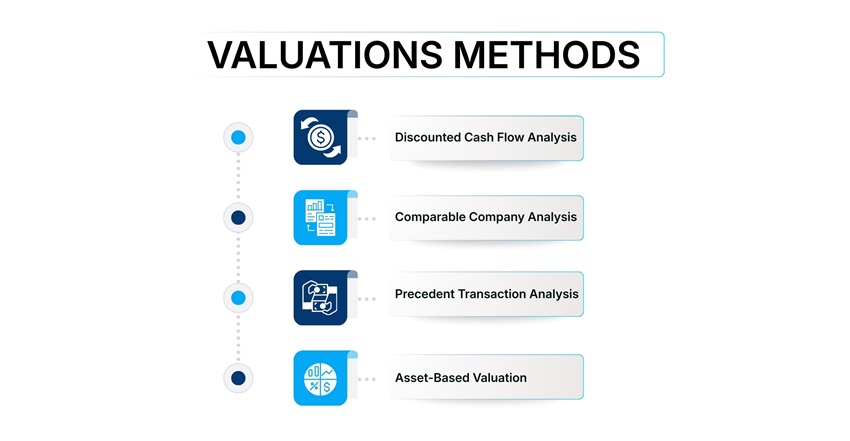
Discounted Cash Flow Analysis is based on intrinsic value through projecting the future cash flows and discounting them to present value. Interviewers explore the nature of the assumptions being formed, how risk is captured in the discount rate, and how candidates justify sensitivity without turning the conversation into a spreadsheet project.
-
Comparable Company Analysis is based on market pricing and value benchmarking. Applicants are evaluated based on peer selection, metric normalization, and the capacity to articulate why multiples vary amongst similar businesses and not to assume that market prices are the objective reality.
-
Precedent Transaction Analysis is a valuation method that measures past deal activity. The approach challenges the knowledge of control premiums, the timing of transactions, and deal-specific factors that have an impact on pricing, not based on operating performance.
-
Asset-Based Valuation is used selectively, usually of asset-intensive or weak companies. Interviewers want to see an explanation of when the balance sheet value is higher than the earnings potential, the quality of assets, and its impact on credibility.
Once a valuation method is selected, attention shifts from the framework itself to the quality of inputs. Interviewers selectively disclose information to see how applicants process incomplete information, how they rationalize assumptions, and how they are internally consistent. This shift preconditions the following step in the case, when analytical discipline and judgment under uncertainty are the main subject of the case, but not the valuation model itself.
Communicating Valuation Insights Clearly
A valuation answer gains traction only when the listener can follow the logic without strain. In a live interview, clarity signals are in control. Begin by putting the conclusion in context, then go through the way the numbers back up. This will assist the interviewers to frame their thoughts prior to information coming in, and not reverse engineer your reasoning.
Effective communication is not sophisticated but is based on structure. Divide your explanation into assumptions, methodology, and implications. Make transitions clear so that the development does not seem to be hasty. Extensive calculations must never be left without a succinct business explanation, particularly in answering case-study interview questions.
Content is as important as delivery. Moderated timing, short pauses, and the appropriate emphasis direct the focus to the things that really matter. Finally, repeat the result of the valuation and its applicability to the decision made. The latter synthesis usually defines the way your performance is recalled in the process of interview preparation and assessment.
Conclusion
The valuation case interviews are those that reward those candidates who are able to incorporate structure, judgment, and clarity during times of pressure. A strong understanding of valuation logic, interview flow, and communication standards enables the candidates to respond well to the case study interview questions. Success in an investment banking case study interview is driven by disciplined analytical thinking rather than mechanical memorization, making structured interview preparation critical for converting technical understanding into well-reasoned, decision-ready insights.
FAQs
How should you approach a DCF question in a case interview?
Start by estimating revenue growth, operating margins, and free cash flow, then discount the projected cash flows using the weighted average cost of capital and calculate a terminal value to estimate the company’s enterprise value.
What are common mistakes candidates make in valuation case interviews?
Common mistakes include jumping into calculations too quickly, ignoring key assumptions, using unrealistic growth projections, and failing to explain the reasoning behind valuation inputs.
How much financial modeling knowledge is required for valuation of case interviews?
Candidates are generally expected to understand the core concepts of financial statements, free cash flow, valuation multiples, and discounted cash flow analysis.
How detailed should calculations be in a valuation case interview?
Interviewers usually expect simplified calculations and clear reasoning rather than a full financial model. The focus is on structured thinking and realistic assumptions.
What industries are commonly used in valuation case interview examples?
Technology, consumer goods, healthcare, and industrial companies are frequently used because they provide clear financial drivers for valuation analysis.